

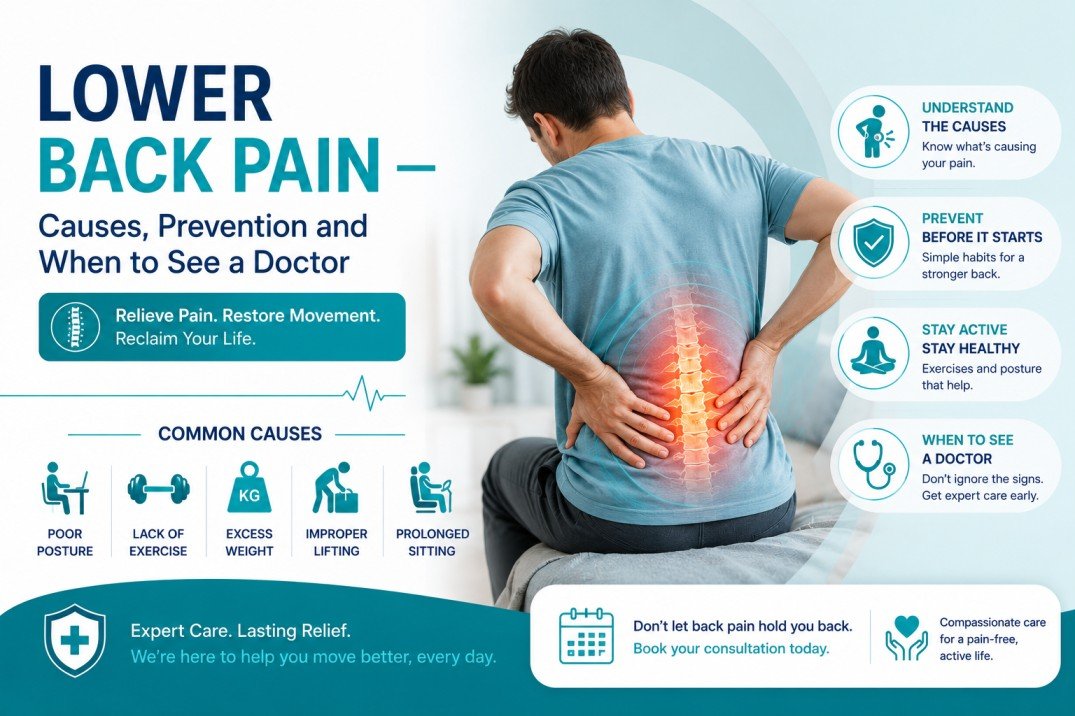
Lower back pain is one of the most common reasons people miss work and seek medical care. Studies estimate that 80% of adults experience significant lower back pain at some point in their lives. The good news is that most cases resolve with conservative treatment — but some require specialist evaluation.
Common Causes of Lower Back Pain
- Muscle strain or spasm — most common, often from lifting incorrectly
- Poor posture — particularly from desk-based or work-from-home setups
- Intervertebral disc problems — disc bulge or herniation
- Degenerative disc disease — gradual wear of discs with age
- Spondylosis — age-related changes in the vertebrae
- Sciatica — pain radiating down one leg due to sciatic nerve compression
Red Flag Symptoms — Seek Immediate Care
- Numbness or tingling radiating down one or both legs
- Weakness in the legs that makes walking difficult
- Loss of bladder or bowel control (cauda equina syndrome — emergency)
- Back pain following a fall or accident
- Unexplained weight loss alongside back pain
- Fever with back pain (possible infection)
Effective Home Management for Mild Back Pain
- Stay active — bed rest beyond 1–2 days slows recovery
- Apply ice in the first 48 hours to reduce inflammation, then switch to heat
- Over-the-counter pain relief as directed by a pharmacist
- Correct your workstation — monitor at eye level, lumbar support
- Sleep on a medium-firm mattress in a side-lying position with a pillow between the knees
The Role of Physiotherapy
Physiotherapy is one of the most effective treatments for both acute and chronic lower back pain. A trained physiotherapist will assess your posture, movement patterns and muscle strength, then design a progressive exercise programme. Most patients see significant improvement within 4–6 weeks of consistent physiotherapy.
When is Surgery Considered?
Surgery for lower back pain is reserved for a small minority of patients — typically those with confirmed disc herniation causing severe nerve compression, or spinal instability not responding to conservative treatment over 6–12 weeks. Our orthopaedic surgeon evaluates each case individually and always exhausts non-surgical options first.
Prevention Tips
- Strengthen your core muscles — planks, bridges, bird-dogs
- Maintain a healthy body weight to reduce spinal load
- Lift objects by bending at the knees, not the waist
- Take regular breaks from prolonged sitting every 45–60 minutes
- Stretch the hip flexors and hamstrings regularly
Book a Consultation
Our Orthopaedics and Spine Surgery team in Medchal offers expert evaluation, physiotherapy and surgical care for all back conditions. Book a consultation today.
📞 +91 73374 49300